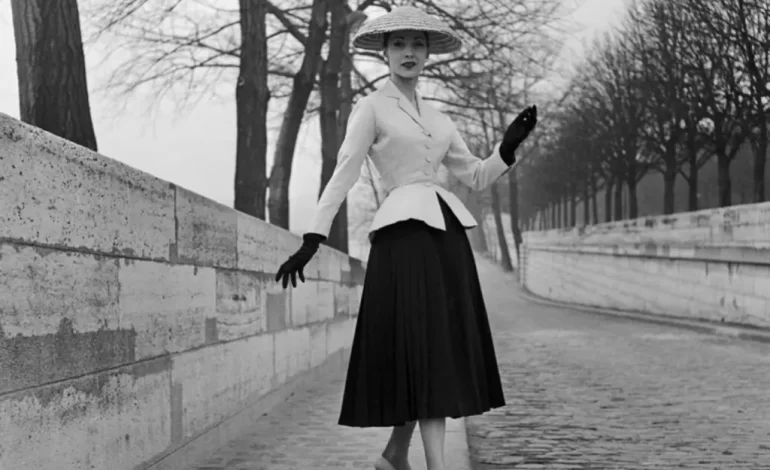

Christian Dior- The Creation Of ‘New Look’
Christian Dior’s renown as one of the greatest couturiers of the twentieth century was launched in 1947 with his debut collection, with which he presented the “New Look.” With rounded shoulders, a nipped waist, and an incredibly full skirt, the “New Look” indulged in ultra-femininity and excess in women’s dress. After years of military and civilian uniforms, sartorial austerity, and shortages, Dior presented not only a new look but a new vision. The New Look was brought in the market due to the lack of fabrics and metals in the market due to the World War. The extravagant usage of fabrics was given a huge halt, hence the New Look was brought in on 12th February 1947. Christian Dior was born in Normandy, France. His family immigrated to Paris with him when he was ten years old. After studying political science, he was in the army. His career as a designer did not begin until 1935 when he came back to Paris and began selling drawings. The designer Robert Piguet hired him in 1938. Dior was in the south of France during World War II, then again in Paris in 1941 and working for Lucien Lelong at a much larger house. In 1946, with the backing of textile manufacturer Marcel Boussac, he opened his own house. Christian Dior- A Walk Down Memory Lane: French fashion designer Christian Dior’s original fashion house was opened in 1946 to produce haute couture clothing. Clothing is now manufactured by Christian Dior Couture, which is owned by LVMH, while Christian Dior SE is a holding company that owns LVMH. Bernard Arnault’s daughter, Delphine Arnault, has been Christian Dior Couture’s CEO since February 2023. Bernard Arnault’s oldest son, Antoine Arnault, is Christian Dior SE’s CEO. “Whatever you do – for business or pleasure – do it with passion! Live with passion,” Christian Dior wrote. Prior to becoming a couturier, Christian Dior was drawn to art. The young Norman native and some friends opened an art gallery when he was 23. In 1938 he learned the métier of the pattern cutter with Robert Piguet and three years later was a designer for Lucien Lelong. Since he opened his Maison in 1946, he made his dreams come true in unbeatable creations, determined to end the stern war years by celebrating sheer delight. His creative genius glorified and enchanted women all around the world. Within ten years, Monsieur Dior revolutionized the codes of femininity and elegance, creating collections full of dreams. Season after season, this unique heritage is reinterpreted by the unique creative passion, energy and contemporaneity of the House’s Creative Directors who – from haute couture to perfumes—make the Dior magic live on with audacity, excellence of savoir-faire and its unique beauty of the gesture. Christian Dior “Bar”Jacket, spring/summer 1947 Dior’s “New Look” collection was a repudiation of the 1920s and 1930s styles, but also, in so many ways, a debt to the styles and body-shapers of the late 19th century. The Bar suit was the most emblematic of the collection, capturing all the characteristics of Dior’s melodramatic atavism. Papers in the Dior archives demonstrate that the original “Bar” suit utilized a notched collar. This shawl collar variant, perhaps the result of a client’s insistence, was formally photographed by Dior at the time of its manufacture, and thus carries the imprimatur of the House of Dior. Although Dior made many notched collars, he was a fervent believer in shawl collars and curved necklines. Perhaps the shawl collar is most successful in conjunction with Dior’s curvilinear lines at shoulders and hips. The notched lapel is more typically found in the cut of Adrian and other suit cutters of the 1940s who preferred angled geometries. The “Bar” suit illustrates also the hand stitching at the inside of the collar and hand-stitched self-covered buttons of the atelier tailleur. “Chérie” – Dinner Dress, Spring/Summer 1947 “Chérie” illustrates “The New Look” in all its meaningful details: sloped shoulder, bustled bustline, nipped waist, and a humongous quantity of skirt sloping away from a padded hipline to under the calf. The New Look appeared uncompromised and finished, not as a tentative proposal or step in the direction of evolution. In this instance, the skirt is constructed of the entire width of fabric, selvage to selvage, unfolded horizontally. Correspondingly, at the waist, folding under of the pleated fullness requires creating a tightened, 13-and-1/2-yard seam allowance, the heavy bulk of which fills out the hips. This tour-de-force accomplishment in dress making was accomplished by the compression of vast volume into a contiguous sculptural diminishment. “Chérie” has more than 13-and-1/2 yards of cloth that are pleated into the wasp waist. The grand to mince accomplishment is only possible by the couturier’s masterful manipulation of material. Dior was proud of the hand work in his designs, especially where the craft allows formal possibility. In this case, the stitches which hold each pleat may actually be felt. Marks of artisanry, they are not zealously concealed. Savoir-Fair Christian Dior’s most valuable heritage, excellence-born savoir-faire, is embodied in every product made by the House, from haute couture to ready-to-wear, from accessories to home furnishings. Exceptional craftsmanship is the alchemy of the preservation of ancient tradition and ongoing innovation. In this it includes not just garments but also handmade bags, jewellery, pumps, scarves and so much more. To Conclude: New Look collection revolutionized the silhouette, and the way garments were styled. Here is her firsthand account of Dior’s first look from her autobiography, In My Fashion. “Paris always does take its fashion news very seriously, and fashion after the war had been stale and tepid. Everybody wanted to believe that Christian Dior could inject life and some fire into this picture.” […Upon arriving at my gold chair within the pale gray salon, where the mantel mirror was adorned with a brilliant baroque floral garland in real flowers executed by Dior, I became conscious of a charged tension there that I never had before had in the couture. Persons who were as yet
Read More